Box of built models
On the table, laid out in three columns. A child picks one up rather than reading it.
Vehicles built out of junk, and run. The roll half of Nature in Motion.
A vehicle built from junk, and made to move. Two chassis and three ways of driving it.
Paired with the wind tunnel as fly. The stock comes from the junk bank beside the table.
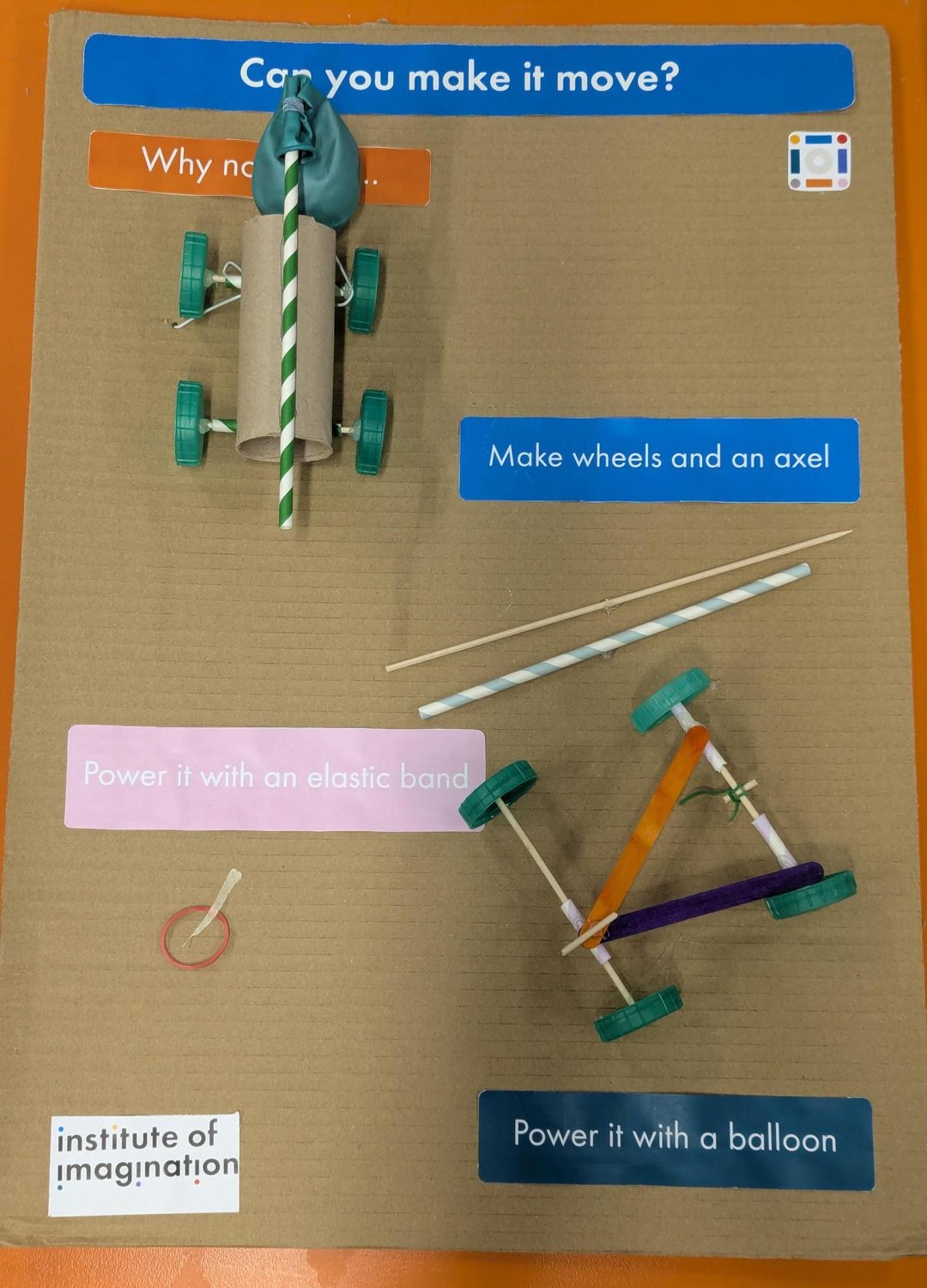
The example board, headed Can you make it move?, with the built vehicles beside it.
A child looks at what is there and takes the drive rather than the design.
Bottle caps, tubes, lids. Everything in the junk bank is a possible wheel, body or axle until a child decides otherwise.
The photographs are in the biomimicry research, filed there under Moon Buggies.
Can you make it move?
What is going to push it?
The example board asks Can you make it move? and answers it in three moves: wheels and an axle, an elastic band, a balloon. Check it before the doors open and rebuild it only if it is damaged. Click the photograph to enlarge it.
On the table, laid out in three columns. A child picks one up rather than reading it.
Two chassis and three drives, drawn separately so a child combines them rather than copying a finished car.
Seen from above. A skewer or a dowel, with a wheel pushed on to each end.
Two sticks crossed, a straw taped across each end. The axles run in the straws.
Skewers pushed straight through a bottle. On a jar they are taped along the underside.
Seen from above. A band round the narrow axle, hooked over a stick laid across the triangle. Winding it stores the turn.
The neck stretched over a straw and taped. The air leaves at the far end.
The bottle top cut into petals, on a band running the length of the body to a peg at the tail.
Most of these come from the junk bank.
Offcuts and failed builds back to the junk bank rather than into the bin.
Scissors back in the pot, the ramp clear.
| Children | Scissors, tape, elastic bands, straws, bottle caps, lids and card. Skewers and dowels, which have sharp ends. |
|---|---|
| Adults | Glue guns. Craft knives, and cutting a bottle open. |
| First aid | Cleaning wipes and plasters. The risks are cuts, and a wound elastic band letting go. |